
Autism support for parents and partners means understanding an autistic person’s communication, sensory experiences, preferences, and support needs without treating autism as something to fix. The World Health Organization describes autism as a diverse group of conditions related to brain development, while the U.S. Centers for Disease Control and Prevention estimates that about 1 in 31 eight-year-old children in the United States was identified as autistic in 2022. Those figures make respectful, practical support relevant to many families, but they do not describe any one person’s abilities or needs. A helpful approach centers the autistic person’s perspective, adapts environments, communicates clearly, and seeks appropriate support while preserving autonomy and dignity.
Understanding autism through a support-first approach
Autism is a lifelong neurodevelopmental variation that can shape communication, social interaction, sensory processing, interests, and patterns of behavior. It is a spectrum: people differ widely, and an individual may have strengths in some areas and substantial support needs in others. The National Institute of Mental Health notes that autism is diagnosed through developmental history and observed behavior; there is no single blood test or brain scan that establishes a diagnosis.
“Understand rather than fix” does not mean ignoring distress, medical needs, or barriers. It means asking what a behavior communicates, identifying what makes participation difficult, and changing support or surroundings before demanding that the person appear less autistic. The National Autistic Society’s guidance on reasonable adjustments similarly emphasizes practical changes that reduce barriers. Support should be individualized, collaborative, and responsive to what the autistic person says or communicates.
Person-centered support defines autism support for families
Person-centered support is an approach that places the autistic person’s preferences, goals, communication, and rights at the center of decisions. The National Institute for Health and Care Excellence (NICE), in guidance on autism in children and young people, recommends taking account of the child’s views and involving them in decisions in a developmentally appropriate way. For adults, the same principle means supporting informed choice rather than assuming that relatives or professionals should decide everything.
This approach has several connected forms: communication support, sensory and environmental accommodations, emotional and practical support, and collaborative care. They work best together. For example, a person who becomes overwhelmed in a noisy shop may benefit from a quieter time to visit, written choices, and the option to leave—not simply encouragement to tolerate the noise.
Respecting autonomy and autistic identity
Autonomy means having meaningful control over one’s body, choices, routines, and personal information, with support where needed. Ask before touching, changing belongings, or sharing details about someone’s diagnosis. Offer choices that are genuine and manageable, and respect a person’s “no” wherever safety and legal responsibilities allow. Some people prefer identity-first language, such as “autistic person”; others prefer person-first language, such as “person with autism.” Ask the individual when possible rather than imposing a universal rule.
Noticing strengths without minimizing support needs
Strengths-based support recognizes interests, skills, persistence, honesty, detailed knowledge, or creative problem-solving without assuming that every autistic person has the same abilities. It also avoids using strengths to dismiss disability-related needs. A person may be highly articulate and still need help with transitions, daily tasks, sensory overload, or understanding implicit social expectations. The useful question is not whether someone is “high” or “low” functioning, but what support helps them participate and feel safe in a particular situation.
Communication support helps parents and partners understand needs
Communication support includes adapting how information is shared and how a person can express choices, needs, feelings, and boundaries. Speech is only one form of communication. Some autistic people use speech consistently; some use sign, writing, pictures, communication devices, or a combination that varies by context. The American Speech-Language-Hearing Association describes augmentative and alternative communication (AAC) as a range of communication methods and tools, from gestures and picture boards to speech-generating devices.
A communication difference should not be mistaken for a lack of understanding or interest. Give extra processing time, use direct language, explain changes explicitly, and avoid asking several questions at once. If a person uses AAC, keep their system available and address the person directly rather than speaking only to a caregiver.
Use clear, concrete, and predictable language
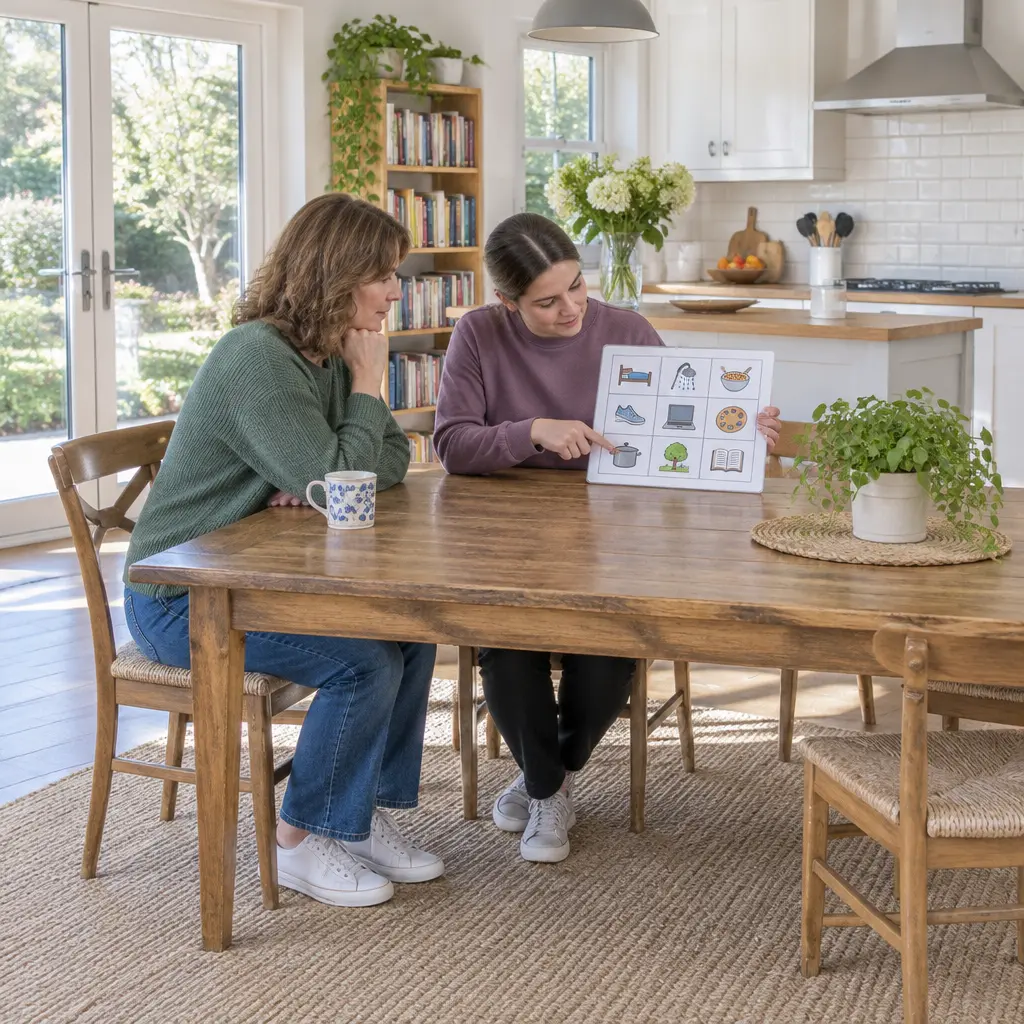
Concrete communication makes expectations easier to interpret. Instead of “Get ready soon,” say, “At 8:15, put on your shoes; then we’ll leave.” Explain figurative language, sarcasm, or implied rules when they matter. Visual schedules, written instructions, and advance notice of changes can reduce uncertainty. These are not accommodations that must be earned; they are tools that make information more accessible.
Treat behavior as information, not defiance by default
Behavior can communicate pain, fatigue, fear, confusion, sensory overload, frustration, or a need for a break. When a person withdraws, repeats a movement, or declines an activity, first consider what happened before the response and what might make the situation safer. The National Autistic Society describes meltdowns as responses to being overwhelmed, rather than deliberate misconduct. A calm response, reduced demands, and a quieter environment may help more than punishment or lengthy explanations during distress.
Sensory accommodations and routines reduce avoidable barriers
Sensory accommodations are changes that address differences in how a person experiences sound, light, touch, taste, smell, movement, or internal bodily signals. Sensory experiences vary: a sound that is barely noticeable to one person may be painful or disorienting to another. NICE guidance recommends considering sensory sensitivities when assessing and supporting autistic children and young people. The practical implication is to ask the individual what helps rather than assuming a particular sensory profile.
Adjust the environment before demanding endurance
Possible adjustments include reducing background noise, choosing softer lighting, allowing comfortable clothing, offering ear protection, providing a quiet space, or planning breaks. For a family gathering, parents or partners might agree on a shorter visit, a low-stimulation room, and a clear way to leave. These changes support access and participation; they are not rewards for behaving conventionally.
Use routines as support, while planning for change
Predictable routines can make daily life easier by reducing uncertainty and decision load. They should be supportive rather than rigid rules imposed without discussion. When plans must change, explain what is changing, what will stay the same, and what options remain. A calendar, countdown, or written sequence may help, but the best tool is the one the person finds useful.
Emotional well-being and professional support belong together
Emotional support means taking a person’s distress seriously and helping them recover without shame. Anxiety, depression, sleep difficulties, and other health concerns can occur alongside autism, but they should not automatically be attributed to autism. A clinician can assess possible medical, mental-health, or environmental causes. The World Health Organization emphasizes that autistic people may have diverse health and support needs, making accessible, coordinated care important.
Seek help for distress, pain, or major changes
A sudden change in sleep, eating, communication, mood, or behavior can signal pain, illness, stress, or another unmet need. Parents and partners can document what changed, when it happens, and what seems to help, then share those observations with a healthcare professional. Seek urgent help when there is immediate danger, severe distress, or concern about self-harm. Support should be accessible and adapted to the person’s communication needs.
Evaluate interventions by their goals and safeguards
An intervention should address a meaningful goal chosen with the autistic person or their representative, such as communicating a need, managing a daily task, or accessing education. Ask what evidence supports it, how progress will be measured, whether the person can refuse, and whether it aims to build useful skills or suppress harmless autistic traits. NICE recommends interventions tailored to the individual and family context. Be cautious of claims to cure autism, guaranteed outcomes, or approaches that rely on fear, coercion, or punishment.
Partnership between parents, partners, and autistic people builds trust
Partnership means making decisions with the autistic person, not merely about them. For children, parents may need to balance safety and development with growing independence. For adult partners, support is reciprocal: each person can explain preferences, negotiate shared responsibilities, and set boundaries. A diagnosis does not make one partner responsible for managing every difficulty, nor does it excuse disrespect or harm.
Create shared plans for difficult moments
A shared plan can identify early signs of overload, preferred ways to offer help, sensory adjustments, trusted contacts, and what to do if a person needs space. Discuss it when everyone is calm and revisit it as needs change. For example, a couple might agree that one partner can pause a conversation and return to it at a specific time, rather than interpreting a need for quiet as rejection.
Support caregivers without making the autistic person a burden
Parents and partners also need rest, reliable information, and social support. Caregiver support can include respite, peer groups, counseling, practical help, and coordination with schools or clinicians. The CDC’s 2022 estimate that 1 in 31 eight-year-old children was identified with autism reflects population-level identification in monitored U.S. communities; it is not a prediction for an individual family. Families differ in access to diagnosis, services, and financial resources, so support systems should avoid blaming caregivers for barriers beyond their control.
A practical example shows understanding in action
Imagine that a child often leaves the dinner table during a noisy family meal. A fix-focused response might repeatedly demand stillness or treat leaving as disrespect. A support-first response asks what makes the meal difficult: overlapping conversations, strong smells, uncomfortable seating, fatigue, or a need for movement. The family could offer a quieter seat, a brief break, a shorter shared meal, or a clear signal for leaving and returning. The goal is not to force a typical-looking dinner; it is to make connection and nourishment more accessible while taking everyone’s needs seriously.
Conclusion: understand, accommodate, and collaborate
Autism support for parents and partners is strongest when person-centered autonomy, accessible communication, sensory accommodations, emotional well-being, and shared decision-making work together. The CDC’s prevalence estimate underscores the broad relevance of informed support, while the diversity of autistic people makes individual listening essential. Start by asking what the person wants, notice what situations help or hinder, and seek qualified support for health or safety concerns. Further learning from autistic-led organizations and reputable clinical guidance can help families replace assumptions with practical understanding.
Sources: Centers for Disease Control and Prevention, “Autism Prevalence Higher, According to Data from 11 ADDM Network Sites,” https://www.cdc.gov/autism/data-research/prevalence/index.html; World Health Organization, “Autism,” https://www.who.int/news-room/fact-sheets/detail/autism-spectrum-disorders; National Institute of Mental Health, “Autism Spectrum Disorder,” https://www.nimh.nih.gov/health/topics/autism-spectrum-disorders-asd; National Institute for Health and Care Excellence, “Autism spectrum disorder in under 19s: support and management,” https://www.nice.org.uk/guidance/cg170; National Autistic Society, “Meltdowns,” https://www.autism.org.uk/advice-and-guidance/topics/behaviour/meltdowns/all-audiences; American Speech-Language-Hearing Association, “Augmentative and Alternative Communication (AAC),” https://www.asha.org/public/speech/disorders/aac/


